Articles
Anduril’s EagleEye: Mission Command and AI in the Warfighter’s Helmet

Marketing and Outreach Team
5 Min Read
A technical review of Anduril’s EagleEye helmet, covering augmented reality, tactical networking and AI-assisted mission command.
TL;DR
Anduril’s EagleEye embeds AI mission command and augmented reality overlays directly into the soldier’s helmet, turning the operator into a node in a distributed, intelligent network. It combines computer vision, edge AI, and real-time data fusion to shorten decision cycles and empower dismounted units with situational dominance.
1. What EagleEye Is
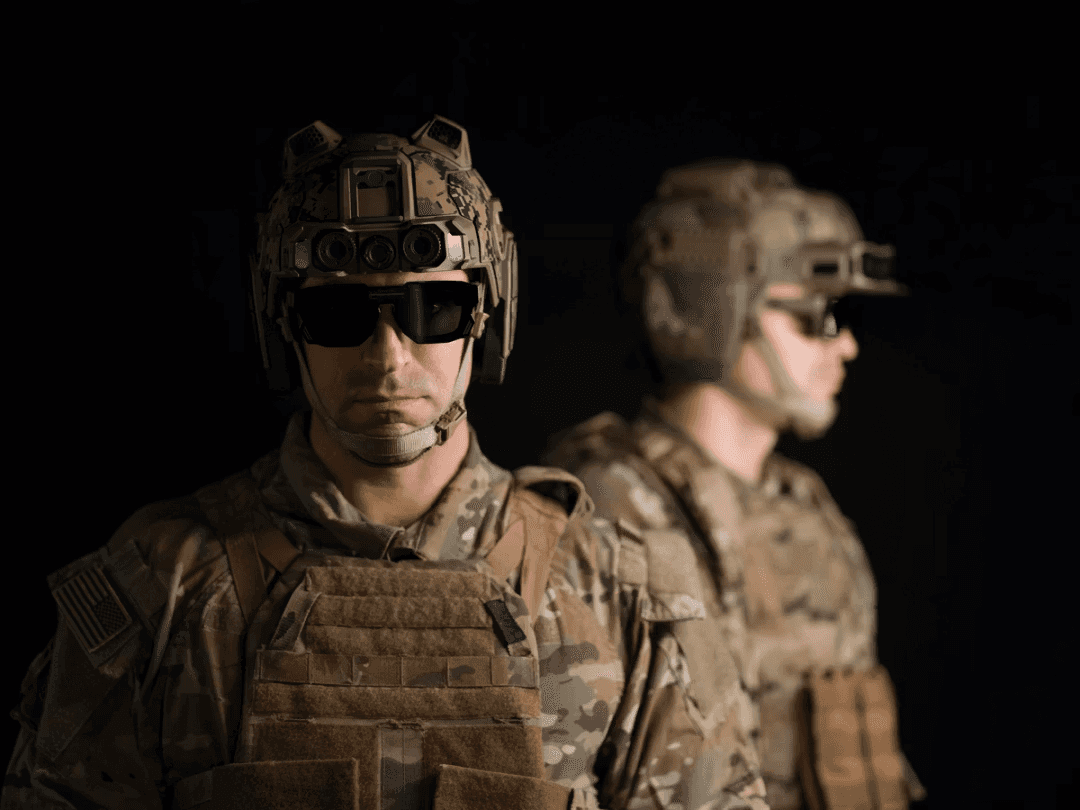
According to Anduril Industries, EagleEye integrates mission command interfaces, sensor fusion, and AI-assisted decisioning directly into the warfighter’s helmet display.
It’s designed to:
Fuse multi-domain sensor feeds (air, land, ISR, and cyber).
Provide a contextual AI overlay within the helmet’s AR interface.
Maintain low-latency links via Anduril’s Lattice OS, its tactical autonomy and command network backbone.
Operate under contested, GPS-denied, and degraded environments.
2. Why This Matters
The battlefield edge is evolving from radio chatter to AI-augmented perception. By embedding command, control, and intelligence directly into the helmet:
Latency drops from seconds to milliseconds.
Situational awareness increases, as soldiers receive real-time cues from sensors, drones, and battlefield AI.
Cognitive loaddecreases, operators act faster with better data.
Human, machine teaming matures from remote control to collaborative autonomy.
This represents a doctrinal shift toward digitised infantry warfare, aligning with programs like the UK’s Future Soldier and the US Army’s Integrated Visual Augmentation System (IVAS).
3. Technical Architecture Overview
EagleEye’s architecture fuses hardware, AI, and network orchestration in a single loop:
Helmet-mounted display (HMD), ruggedised optics for AR overlays.
Edge compute node, performs inference locally, often on an NVIDIA Jetson or custom ASIC.
Lattice OS, Anduril’s proprietary C2 mesh linking drones, sensors, and helmets.
AI model pipeline, trained for object recognition, threat prioritisation, and contextual mapping.
Secure mesh comms, integrates RF, cellular, and SATCOM links with adaptive routing.
Each helmet becomes both a data consumer and sensor node, part of a self-healing tactical network.
4. Use Cases and Scenarios
Urban ISR operations: fused feeds from micro-UAVs, ground sensors, and LIDAR form a live 3D battlespace overlay.
Search and rescue: computer vision highlights heat signatures or movement in collapsed structures.
Border patrol: AI classifies vehicles, movement patterns, and anomalies across wide terrain.
Training and simulation: live or recorded mission playback via augmented overlays.
The helmet’s AI turns raw sensor noise into actionable cues, critical where bandwidth, time, and clarity all compete.
5. Integration with the Defence Ecosystem
EagleEye aligns with an emerging ecosystem of soldier systems and networked autonomy:
Anduril Lattice OS acts as the tactical “nervous system.”
Teledyne FLIR and Collins Aerospace are investing in sensor fusion standards.
BAE Systems’ Strix and Elbit Systems’ Torch-X are developing parallel digital soldier frameworks.
The NATO DIANA accelerator continues funding adaptive human-machine teaming research across allied nations.
These ecosystems are converging into a unified vision: AI-driven, resilient command systems that merge digital and kinetic domains.
6. Risks and Challenges
a) Cybersecurity
AI-assisted systems amplify the attack surface:
Malicious data injection (spoofed feeds).
Model poisoning or adversarial inference.
Firmware compromise in helmet compute modules.
b) Electromagnetic and EW Threats
Spectrum congestion and jamming can degrade overlay fidelity. Mesh resilience and frequency agility are mandatory.
c) Cognitive Overload
AR interfaces risk flooding operators with excessive or ambiguous data. UI design must emphasise signal-to-noise clarity and cognitive ergonomics.
d) Data Governance
Battlefield AI systems inherently collect biometric and environmental data. Clear frameworks for lawful use, minimisation, and classification are essential.
7. The AI Perspective
EagleEye embodies edge AI fusion, embedding inference as close as possible to the point of decision.
Advantages:
Reduced latency (less cloud dependency).
Bandwidth efficiency via local processing.
Autonomy continuity even in disconnected operations.
Challenges:Requires reliable on-device compute.
Demands continuous model verification.
Must withstand thermal and kinetic stress.
This trend mirrors advances in commercial edge AI hardware, NVIDIA Orin, Hailo, and Tenstorrent, adapted for rugged military deployments.
8. Policy Context
Governments are formalising ethical and operational frameworks for AI in combat systems:
NATO AI Strategy (2023), emphasises reliability, explainability, and traceability.
US DoD Responsible AI Implementation Plan (2024), prioritises algorithmic audit and operator accountability.
UK MoD Defence AI Centre is drafting verification standards for tactical autonomy.
EagleEye aligns with these policies by placing humans inside the command loop while accelerating perception and coordination.
9. Comparative Landscape
System | Country | Capability Focus | Notes |
|---|---|---|---|
Anduril EagleEye | USA | AI mission command, AR overlays | Integrated with Lattice OS |
Elbit Torch-X Dismounted | Israel | Digital soldier system | Integrates with helmet HUDs |
BAE Strix Helmet | UK | Sensor fusion and C2 overlays | Part of Tempest programme |
Microsoft IVAS | USA | AR + mission management | Partnered with U.S. Army |
Thales Scorpion Suite | France | Battlefield networking | Modular soldier integration |
This shows a global race to embed C2, AI, and sensory intelligence directly into the individual operator.
10. Future Outlook
Full multi-domain fusion: Helmets, UAVs, UGVs, and satellites form one adaptive network.
Quantum-safe communications: integration of post-quantum encryption for future adversary resilience.
Bio-telemetry overlays: combining health and stress data for unit commanders.
Synthetic training data loops: continuous retraining of battlefield AI using helmet-collected data.
Open standards: NATO likely to push for common interoperability across all coalition systems by 2030.
EagleEye is an early realisation of the networked soldier concept, merging cognitive AI, autonomy, and wearable hardware in the same system.
External References
Join our newsletter list
Sign up to get the most recent blog articles in your email every week.

Author
Marketing and Outreach Team
AIC’s Marketing and Outreach Team builds visibility and trust across Defence and security. We deliver strategic campaigns, thought leadership, and stakeholder engagement while balancing transparency with discretion. Our mission is to position AIC as a trusted, innovative partner to the UK MoD and beyond.